Home / The End
On the novel this address was named for
The End by Salvatore Scibona: a reader's guide to the novel
A reader's guide to Salvatore Scibona's The End: its Ohio neighborhood in 1953, its people, its long sentences, its themes and a spoiler-flagged look at the ending.

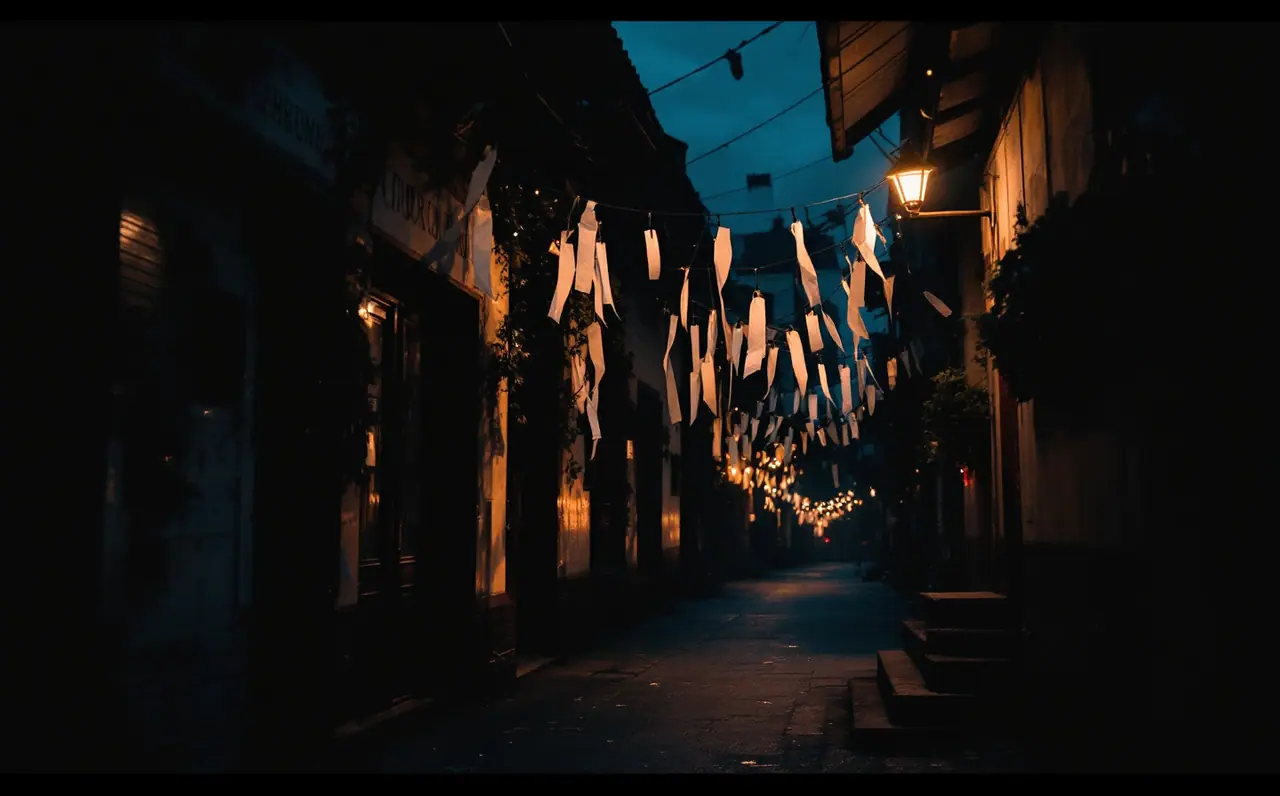
The End is the first novel by Salvatore Scibona, published by Graywolf Press in 2008. It is a demanding book and a generous one. It asks you to hold a crowd of people in your head, to read sentences that take their time arriving, and to accept that the story will not move in a straight line. In return it gives you a whole neighborhood, built from the inside, and an ending that keeps working on you after you close the book. This guide is written for readers and book groups who want a map before they start, or a second opinion once they have finished.
The first half of this page stays clear of spoilers. A marked section near the end discusses how the novel closes.
What kind of book it is
The End is a literary novel about an Italian immigrant community in the Midwest, told through several characters whose lives cross on one hot summer day. It is not a family saga in the usual sense, and it is not a crime novel, although a crime sits at its center. The closest description might be a choral novel: one day, many inner lives, and a long reach back into the decades that made those lives what they are.
Reviewers in its first year reached for big comparisons. NPR's Lynn Neary, introducing an interview with Scibona in November 2008, listed Saul Bellow, Virginia Woolf, William Faulkner and James Joyce. Those names tell you something useful about the texture of the prose (dense, interior, attentive to how a mind moves) even if the book is very much its own thing. Kirkus called it demanding but rewarding, which is fair warning and fair praise at once.
Where and when it is set
The novel opens on August 15, 1953, the Feast of the Assumption, in a neighborhood called Elephant Park. The publisher describes it as an Italian immigrant enclave in Ohio, and reviewers and interviewers place it in Cleveland, the city where Scibona's grandparents grew up. In interviews Scibona has said he built the neighborhood from the kind of place his grandparents knew in Depression-era Cleveland, and that a real incident at a Cleveland parish festival helped shape the book. Elephant Park itself is his invention, so do not go looking for it on a map.
The day matters. Once a year, on the feast, outsiders pour into the neighborhood for a street carnival with games and food, and the statue of the Virgin is carried out of the church and through the streets in a procession. The Korean War has just ended. The neighborhood is changing: the children of the first immigrants are moving up and out, and Black families are moving into nearby streets. All of that pressure is present on the carnival day.
From that single day the novel travels back across roughly seven decades of these people's lives, to childhoods, marriages, emigrations and old wounds, and then returns to the carnival.
The main characters
You will meet a lot of people, but a handful carry the book. Here they are with only the setup the first pages give you.
| Character | Who they are when we meet them |
|---|---|
| Rocco LaGrassa | The neighborhood baker. On the feast day he learns that his son has died in a prisoner of war camp in Korea, and he refuses to believe it. His wife and other sons left him years ago. |
| Costanza Marini | A very old, childless widow, sharp and well off, who for decades has quietly performed illegal abortions. She still talks with her dead husband in her head. |
| Lina Mazzone | A seamstress who works with Mrs. Marini and is learning her other trade. She has come back to Elephant Park after years away. |
| Ciccio Mazzone | Lina's teenage son, who has spent much of his life in Mrs. Marini's company and has not forgiven his mother for leaving. |
| The jeweler | A man from the neighborhood glimpsed in the carnival crowd. The novel takes its time telling you who he is. |
There are others, including a second-generation son who has done well beyond the neighborhood, and several figures from the old days who appear in the backward sections. If you are reading for a group, an index card with these five names and a few words each will save you some flipping back.
How the structure moves through time
The novel begins with Rocco and stays close to him for its opening section. Then it leaves him, which surprises many first-time readers, and turns to the others, moving back into their pasts and forward again. Scibona told the Fiction Writers Review that he wrote Rocco's section last, and in his NPR interview he compared the book's shape to a Bach partita: a simple theme stated at the start, then elaborated and complicated, until the theme returns plainly at the end. That is a helpful way to read it. The carnival day is the theme. Each backward section is a variation that makes the day sound different when you hear it again.
In practice this means you should not worry about losing Rocco. He is the first statement of the melody. The book is building toward a return to August 15, and when it gets there you see the same streets with far more knowledge than you had on page one.
A few practical habits help:
- Note the year or the age of the character whenever a new section starts. The novel often tells you, but quietly.
- Expect each long section to belong mainly to one consciousness. Ask "whose head am I in?" before "what is happening?"
- Treat early mysteries as deliberate. If something is withheld, it is usually withheld on purpose and will come back.
Reading the long sentences
The prose is the reason some readers love this book and the reason others stall. Scibona's sentences pile up place, time and sensation before they reach their subject, and they use odd, exact words where an ordinary one would be easier. The rhythm is close to the rhythm of thought, not of report.
Here is a worked example of how one of those sentences behaves, described rather than quoted. Early on, there is a sentence about dread catching up with Rocco before dawn. It opens with time phrases (the small hours, later at four in the morning), then wanders down wet alleys under tenement balconies where children sleep beneath the laundry and the coal smoke hangs yellow, then moves inside to the bakery and the rows of loaves rising "slowly but slowly" on their shelves. Only after all of that does dread arrive and hit him. The structure is the meaning. Rocco's ordinary working morning is so full and so familiar that grief has to push through it to reach him, and the sentence makes you wait the way he waits.
If you find yourself lost in a sentence like that:
- Find the main verb. Everything else is weather around it.
- Read the sentence aloud once, at walking pace. Many of them are built for the ear.
- Do not stop to look up every unusual word on a first pass. Underline and move on.
- Give each new section ten pages before judging it. The voice changes with the character, and it takes a few pages to tune in.
I read the Rocco section twice before I went on, which I rarely do, and it made the rest of the book much easier.
The themes worth talking about
Immigrant families and what they lose
Almost everyone in Elephant Park came from Italy or was raised by people who did. The novel is less interested in nostalgia for the old country than in the price of staying and the price of leaving. Children grow away from parents, wives leave husbands, and the neighborhood itself is starting to empty as the next generation moves on.
Faith and the Feast of the Assumption
The Assumption is the feast of Mary taken bodily into heaven, the end of her earthly life. A book called The End set on that day is asking about endings of every kind, including the end of belief. Several characters carry a hope or a faith that the day tests. Scibona has said in interviews that Rocco's crisis is a pattern the other characters repeat, each in their own way.
Work and money
This is a book about how people earn a living: baking bread before dawn, sewing drapery, selling jewelry, and in Mrs. Marini's case a secret trade that has made her comfortable. Watch where the money in the neighborhood comes from and who knows about it. It tells you a lot about who holds power.
Race and the crowd
The procession is a public display of belonging, and on this day it meets Black newcomers to the area. The book watches the crowd's fear and hostility build from the street level, through overheard talk and small gestures, and it does not let the community off lightly.
Violence and the end of an era
There is violence in the book, some of it long in the past, and it shapes the present in ways the characters cannot always see. Underneath everything is a sense that this neighborhood, and a whole way of immigrant life in American cities, is coming to a close.
How the novel ends
Spoilers for the ending of The End follow. Skip to the discussion questions if you have not finished the book.
The novel does return to August 15, 1953, as the opening promised, and the carnival day is now crowded with everything you have learned. Several threads close; one of the most important stays open.
Rocco's story breaks off. He leaves Elephant Park to find his wife and sons, and his last major scene is a strange, crossed conversation with an ice cream vendor at Niagara Falls, near the Canadian border, where each man seems to be talking to himself. Scibona has described that moment as the point where Rocco's faith fails. The book never tells you what becomes of him afterward. Some reviewers found that frustrating. I think it is the point: the novel begins with a man who will not accept an ending, and it refuses to give him a neat one.
The other revelation the late chapters turn on is the jeweler's crime. Scibona has said the novel grew from the image of a man climbing a flight of stairs, and that the man on the stairs became the criminal whose act sets the whole story in motion. The book slowly exposes how that crime ties these households together, and reviewers who give the twist away connect it to the secret of how Ciccio came to be born. Once you know it, much of the earlier behavior of Lina, Ciccio and Mrs. Marini looks different.
The book ends inside Mrs. Marini's mind, in her long, private conversation with her dead husband. That choice moves the weight away from plot and onto memory: past and present sit together in one old woman's thoughts, and the day's events become one more thing she carries.
Scibona told the Fiction Writers Review that this is "the kind of ending we get in life", and compared it to the Iliad, which resolves when Achilles' rage is put to rest, not when the story's events are tidied up. What the ending asks of you is to accept emotional resolution without full information. You know enough to feel the weight of what happened. You do not get to know everything, and neither do the people of Elephant Park.
A note on links Some links on this page go to bookstores, magazine stores, course sites or publishing services, and Last Chapter can earn a commission when you buy through them. It costs you nothing extra.
Discussion questions for book groups
- The novel begins with Rocco and then leaves him for most of the book. How did losing him change the way you read the other characters?
- Rocco insists the news of his son's death is a mistake. Where else in the book do people refuse to accept what they have been told, and what does that refusal protect?
- Mrs. Marini performs illegal abortions and is also the most loyal adult in Ciccio's life. Did your judgment of her change as the book went on? What made it change?
- Which character in the carnival crowd sees most clearly what is happening between the procession and the Black newcomers, and which is most blind to it?
- Follow the money: bread, drapery, jewelry, Mrs. Marini's trade. Who has money in Elephant Park, how did they get it, and who knows?
- The title can point to a death, the end of a marriage, the end of faith or the end of a neighborhood. Which ending felt most important to you?
- Choose one long sentence that you loved or that defeated you, and read it aloud to the group. Does hearing it change your view of the style?
- Fathers in this novel are missing, dead, unknown or distant. What does the book suggest about what a father owes a son, and what a son can do without one?
- The novel is set on the feast of a woman taken up into heaven. How do the women of Elephant Park (Mrs. Marini, Lina, Rocco's absent wife) rise above or stay bound by their circumstances?
- Imagine the book told in strict chronological order. What would you gain, and what would be lost?
If you liked it, read next
- Christ in Concrete by Pietro di Donato (1939): Italian immigrant bricklayers in New York, told in a heated, almost biblical prose that rewards patience the way Scibona's does.
- Winesburg, Ohio by Sherwood Anderson (1919): linked stories of one small Ohio town and its lonely, secretive people, an older cousin of Elephant Park.
- Mrs Dalloway by Virginia Woolf (1925): one June day in London, moving from mind to mind, and the clearest ancestor of Scibona's one-day structure.
- Independent People by Halldór Laxness (first published in Icelandic in the 1930s): a stubborn sheep farmer, a hard life on poor land, and a novel Scibona has recommended to readers in interviews.
- The Bluest Eye by Toni Morrison (1970): another first novel about a single Ohio community, Lorain in 1941, and the damage its families do and suffer.
For more on the novelist and his second book, see our profile of Salvatore Scibona and his novels. For the reviews, interviews and prize pages behind this guide, see further reading on The End. Other guides of this kind live on our reading guides shelf, and essays about how books close are on the endings shelf.